- Space
- Astronomy
- Black Holes
A strange X-ray signal spotted decades ago may be the result of a star that got attacked by two black holes, one after the other.
0 Comments Join the conversationWhen you purchase through links on our site, we may earn an affiliate commission. Here’s how it works.
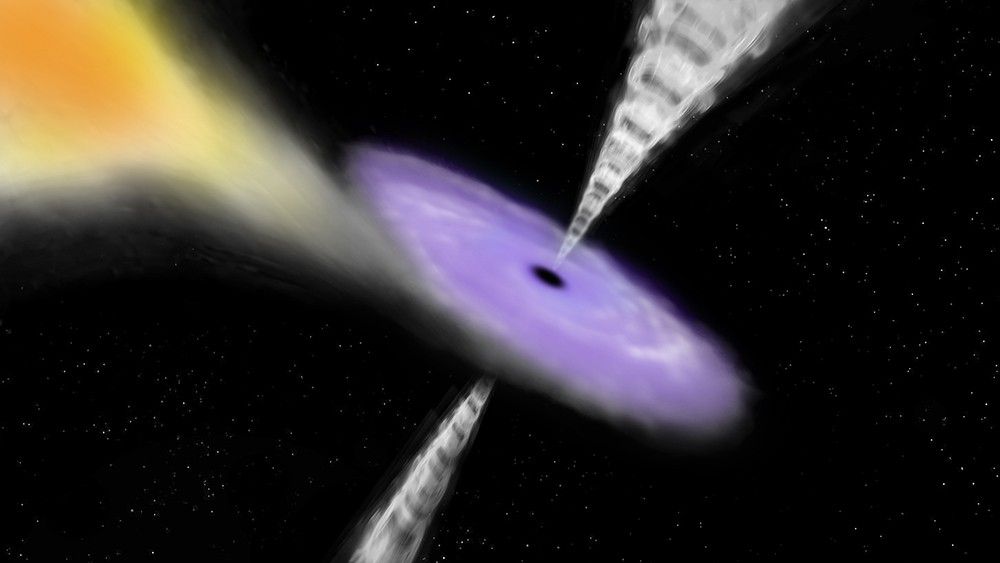
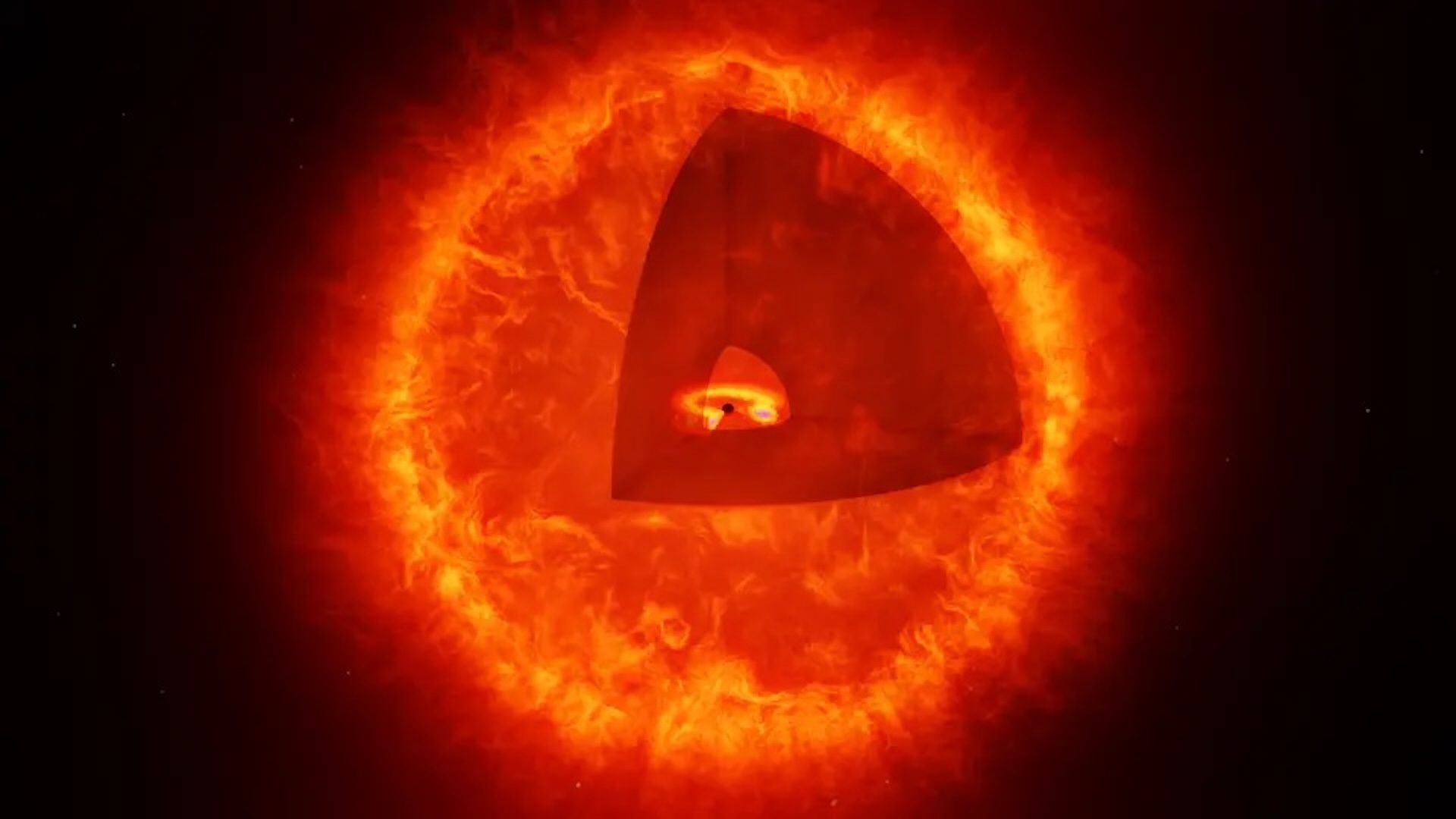
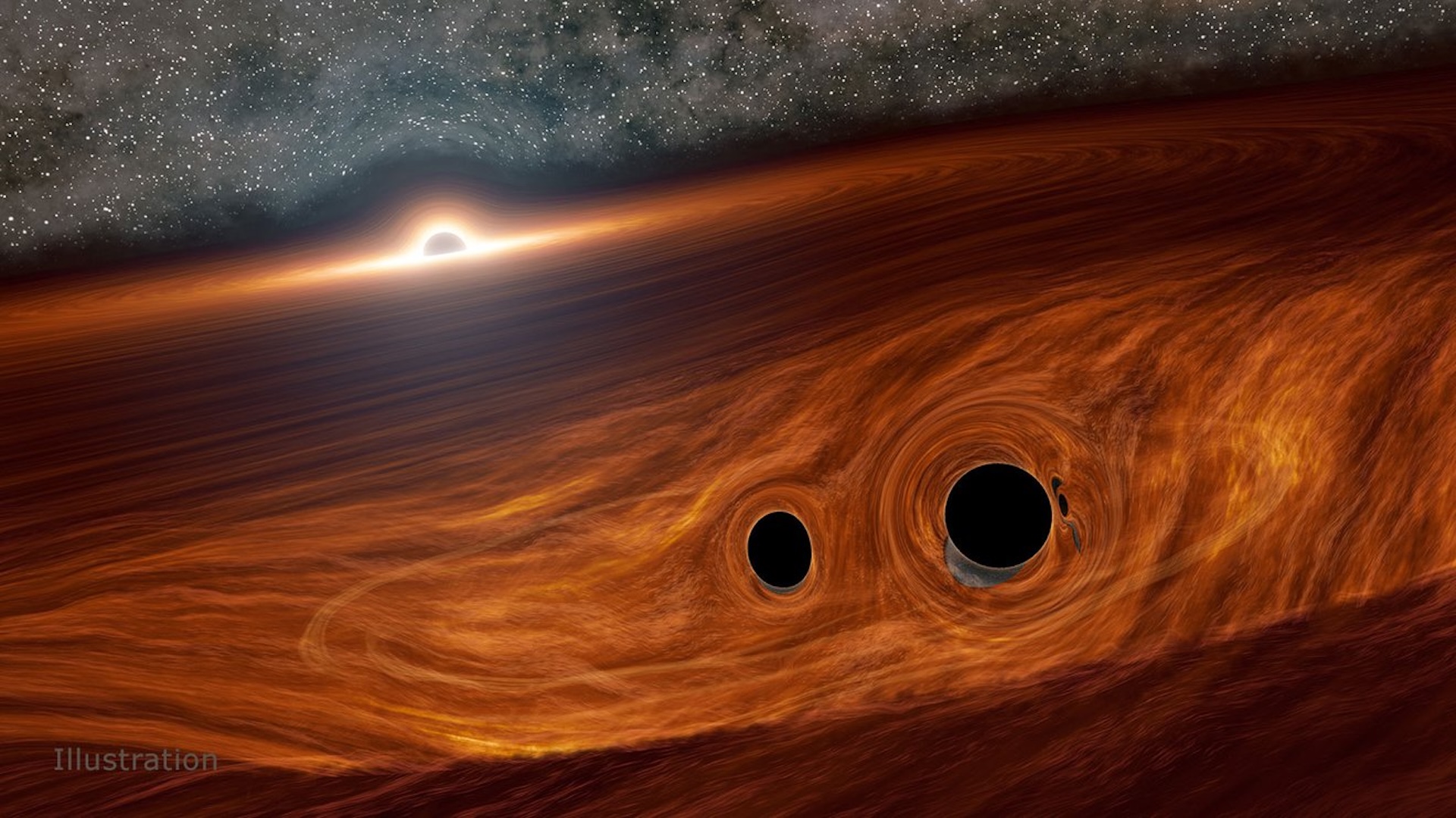
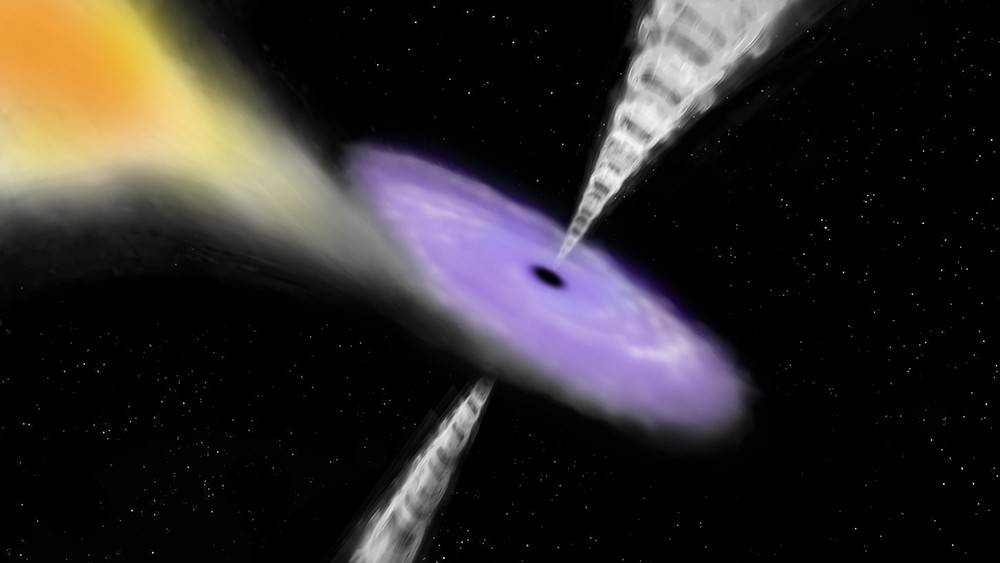 Black holes rip matter away from any unlucky stars that come too close. Now, scientists think they've seen two black holes that feasted on the same star in a back-to-back attack.
(Image credit: ESA/ATG medialab)
Black holes rip matter away from any unlucky stars that come too close. Now, scientists think they've seen two black holes that feasted on the same star in a back-to-back attack.
(Image credit: ESA/ATG medialab)
About 3 billion years ago, a hapless star got caught in a twisted tug-of-war between two gigantic black holes — and now, we are seeing the faint screams of X-rays emanating from this violent event. If confirmed, it could be the most distant episode of two black holes attacking a star ever seen.
An international team of astronomers reported their decades-long observation of the faintest known variable X-ray flare in a paper accepted for publication in the journal The Innovation in November.
You may like-
 Record-breaking black hole collision finally explained
-
 Stars live longer, stranger lives after nearly being swallowed by a black hole
-
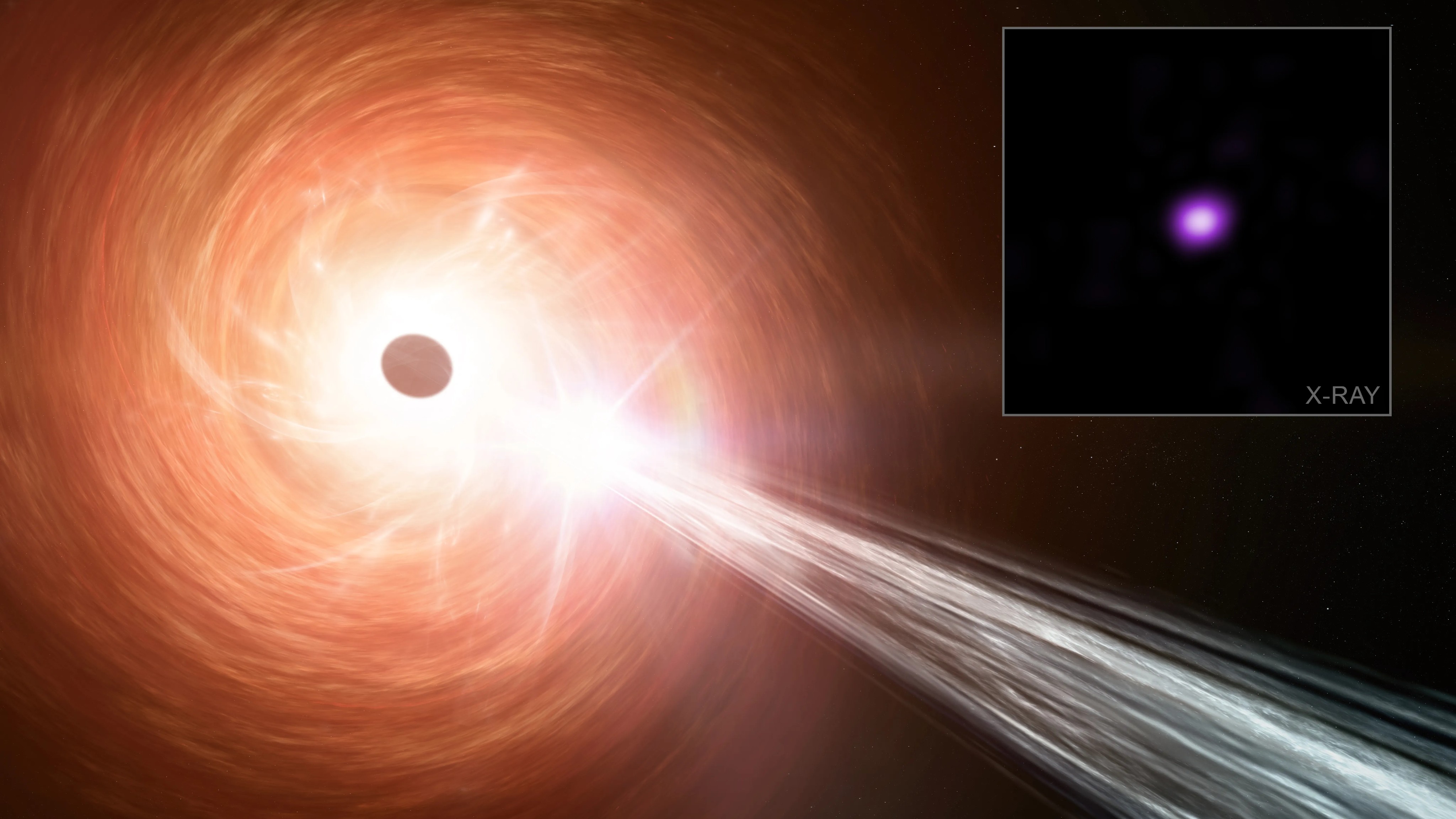
 'Shocking': Black hole found growing at 2.4 times the theoretical limit
Making stellar spaghetti
A bright surge in X-rays followed by a long span of dimming is exactly what astronomers expect from violent encounters called tidal disruption events (TDEs), which happen when a star wanders too close to a supermassive black hole. Before the star is swallowed by the monster's event horizon (the point of no return), the black hole's enormous gravity rips the star to shreds — a process cutely dubbed "spaghettification," as if the star were being pulled into a thin strand of pasta.
The stellar material then settles into a thin, rapidly rotating disk just outside the black hole. The energy released by this process makes the gas so hot that it emits X-ray radiation that's visible even from the other side of the universe. Then, the material funnels its way to the gaping maw of the black hole itself, and the disk loses brightness.
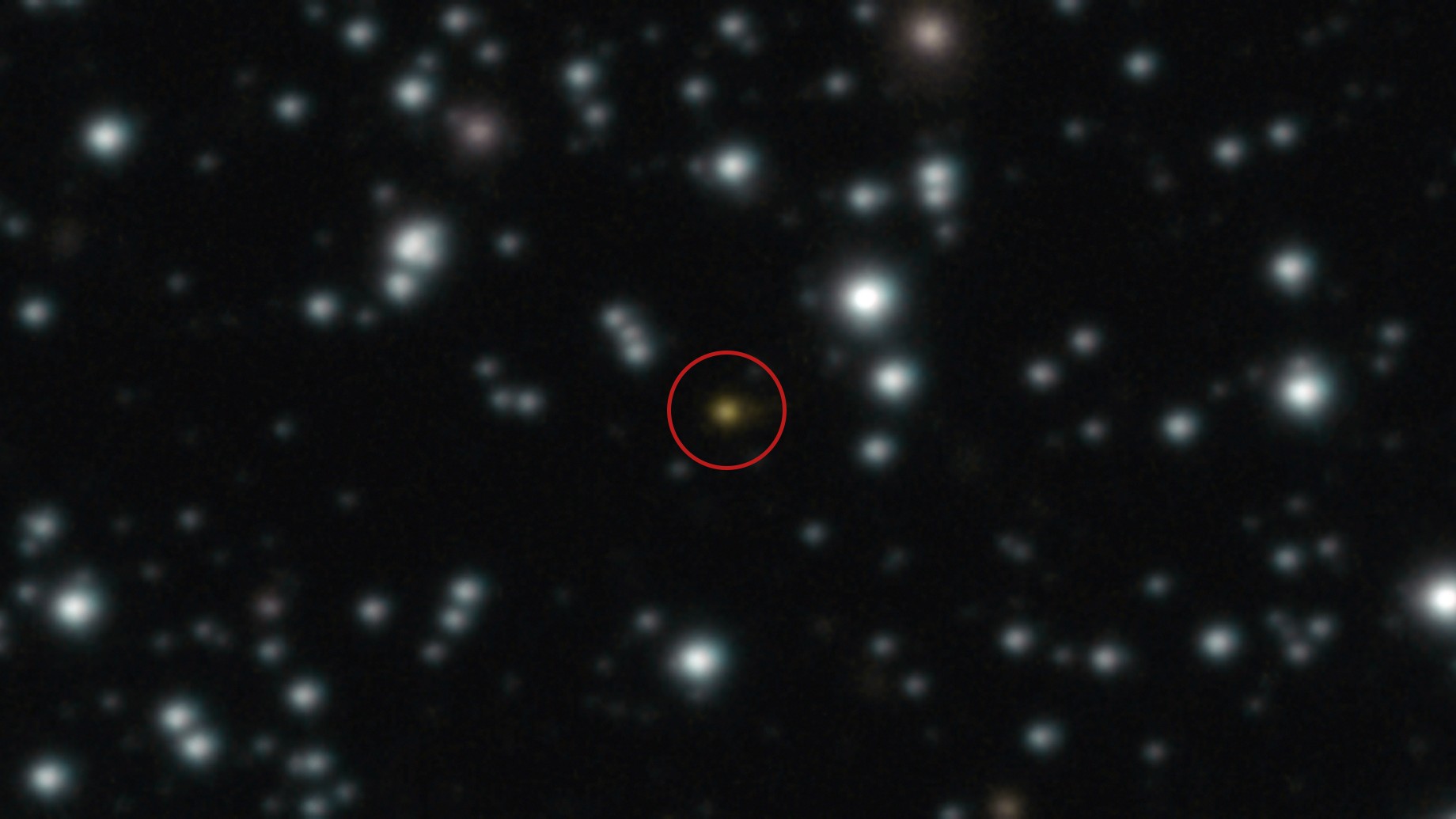
XID 925 was already remarkable, as it was one of the most distant and faintest known TDEs ever recorded. But in 1999, it all went haywire.
Between January and March of that year, XID 925 rapidly and unexpectedly brightened by a factor of 27. Then, the X-ray brightness collapsed just as quickly as it appeared, and XID 925 continued to fade from the scene.
Sign up for the Live Science daily newsletter nowContact me with news and offers from other Future brandsReceive email from us on behalf of our trusted partners or sponsorsBy submitting your information you agree to the Terms & Conditions and Privacy Policy and are aged 16 or over.A back-to-back black hole attack
Now, the astronomers behind the new study believe there is another culprit behind this strange brightening. This is no simple case of a TDE around a single supermassive black hole. This is a case of a TDE around two supermassive black holes.
related stories—'Unlike any we've ever seen': Record-breaking black hole eruption is brighter than 10 trillion suns
—'Not so exotic anymore': The James Webb telescope is unraveling the truth about the universe's first black holes
—'Torn apart by the darkness': What would happen if a human fell into a black hole?
They argue that the unlucky star was caught in the gravitational embrace of a central gigantic black hole and another, smaller (but still large in its own right) companion black hole. The larger black hole tore apart the star and transformed it into an accretion disk. But then, the second black hole swung close to the disk, or even plowed right through it, and this disruption led to a furious burst of energies, the scientists explained.
Like a hapless car crashing into the scene of an accident, the event made a messy situation even messier — in this case, by triggering the release of even more X-rays. Once the smaller black hole moved on, the system returned to normal.
While the astronomers cautioned that this story doesn't perfectly explain all of the data, they argued that it's the most compelling scenario given what we know. If it is true, it would be the most distant known binary black hole tidal disruption event, giving us a crucial and exciting window into the complex relationships between stars and black holes in the hearts of young galaxies.
 Paul SutterSocial Links NavigationAstrophysicist
Paul M. Sutter is a research professor in astrophysics at SUNY Stony Brook University and the Flatiron Institute in New York City. He regularly appears on TV and podcasts, including "Ask a Spaceman." He is the author of two books, "Your Place in the Universe" and "How to Die in Space," and is a regular contributor to Space.com, Live Science, and more. Paul received his PhD in Physics from the University of Illinois at Urbana-Champaign in 2011, and spent three years at the Paris Institute of Astrophysics, followed by a research fellowship in Trieste, Italy.
You must confirm your public display name before commenting
Please logout and then login again, you will then be prompted to enter your display name.
Logout Read more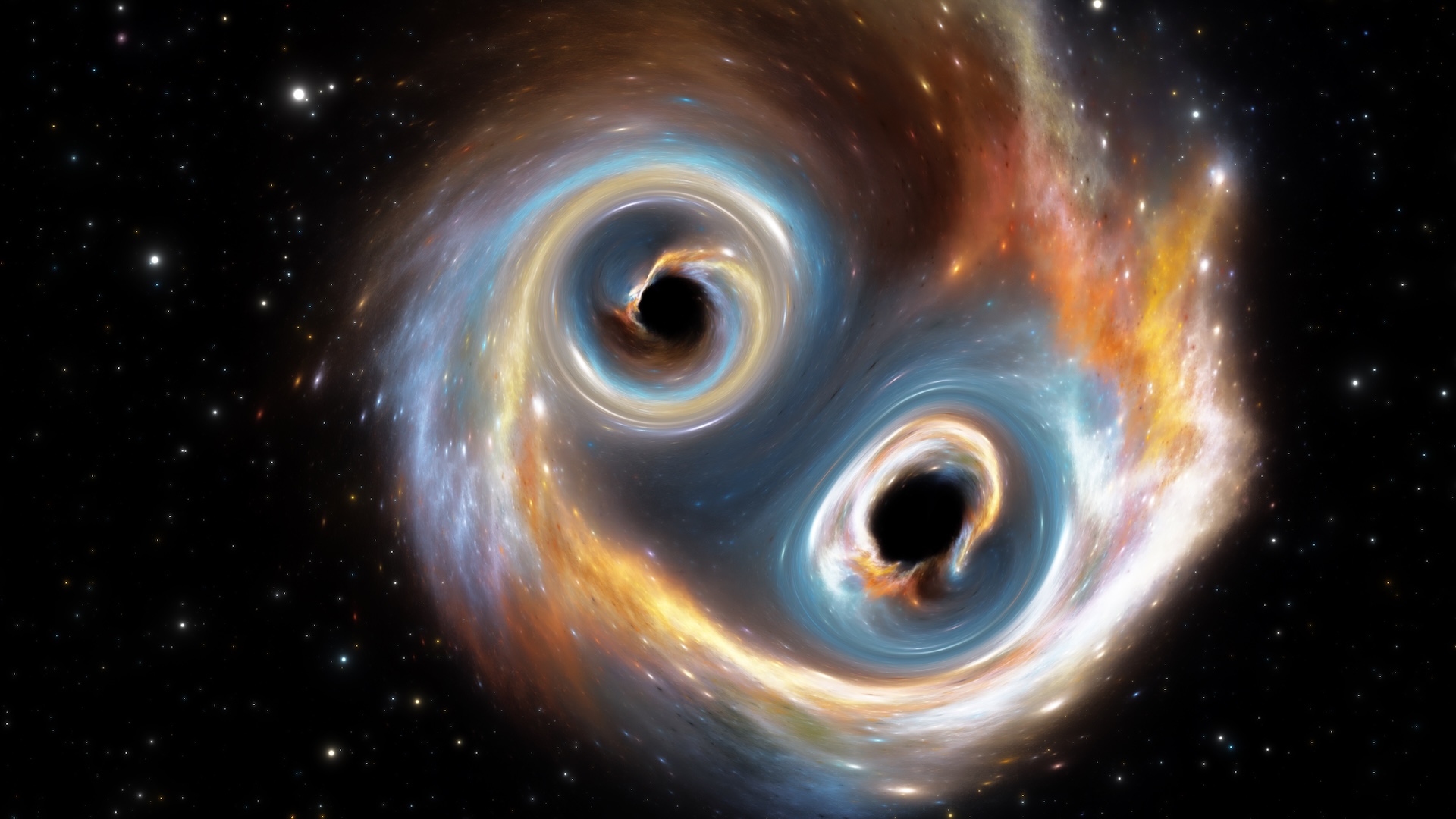 Record-breaking black hole collision finally explained
 Stars live longer, stranger lives after nearly being swallowed by a black hole
 'Shocking': Black hole found growing at 2.4 times the theoretical limit
 Groundbreaking image shows two black holes orbiting each other for first time
 Mysterious cosmic explosion can't be explained, scientists say
 The James Webb telescope may have discovered a brand new class of cosmic object: the black hole star
Latest in Black Holes
The James Webb telescope may have discovered a brand new class of cosmic object: the black hole star
Latest in Black Holes
 James Webb telescope may have discovered the earliest, most distant black hole ever seen
Record-breaking black hole collision finally explained
James Webb telescope may have discovered the earliest, most distant black hole ever seen
Record-breaking black hole collision finally explained
 'Unlike any we've ever seen': Record-breaking black hole eruption is brighter than 10 trillion suns
 'Torn apart by the darkness': What would happen if a human fell into a black hole?
 'Not so exotic anymore': The James Webb telescope is unraveling the truth about the universe's first black holes
 Physicists detect rare 'second-generation' black holes that prove Einstein right... again
Latest in News
Scientists spot 2 black holes that took turns slaughtering 1 unlucky star
Physicists detect rare 'second-generation' black holes that prove Einstein right... again
Latest in News
Scientists spot 2 black holes that took turns slaughtering 1 unlucky star
 Amazon rainforest is transitioning to a 'hypertropical' climate — and trees won't survive that for long
 'It is the most exciting discovery in my 40-year career': Archaeologists uncover evidence that Neanderthals made fire 400,000 years ago in England
 This bright star will soon die in a nuclear explosion — and could be visible in Earth's daytime skies
 'It is simply too hot to handle': 2024 was Arab region's hottest year on record, first-of-its-kind climate report reveals
 Russia's Bezymianny volcano blew itself apart 69 years ago. It's now almost completely regrown.
LATEST ARTICLES
Russia's Bezymianny volcano blew itself apart 69 years ago. It's now almost completely regrown.
LATEST ARTICLES- 1Amazon rainforest is transitioning to a 'hypertropical' climate — and trees won't survive that for long
- 2Scientists create new solid-state sodium-ion battery — they say it'll make EVs cheaper and safer
- 3'It is the most exciting discovery in my 40-year career': Archaeologists uncover evidence that Neanderthals made fire 400,000 years ago in England
- 4Russia's Bezymianny volcano blew itself apart 69 years ago. It's now almost completely regrown.
- 5The 17 best fitness gifts to buy for gym lovers, hand-picked by a personal trainer